TL;DR
AI makes real estate marketing faster and more scalable, while traditional marketing builds trust and buyer confidence. The strongest strategies combine both to help buyers understand options clearly and move forward with confidence.
The New Equation: Speed Meets Trust in Real Estate Marketing

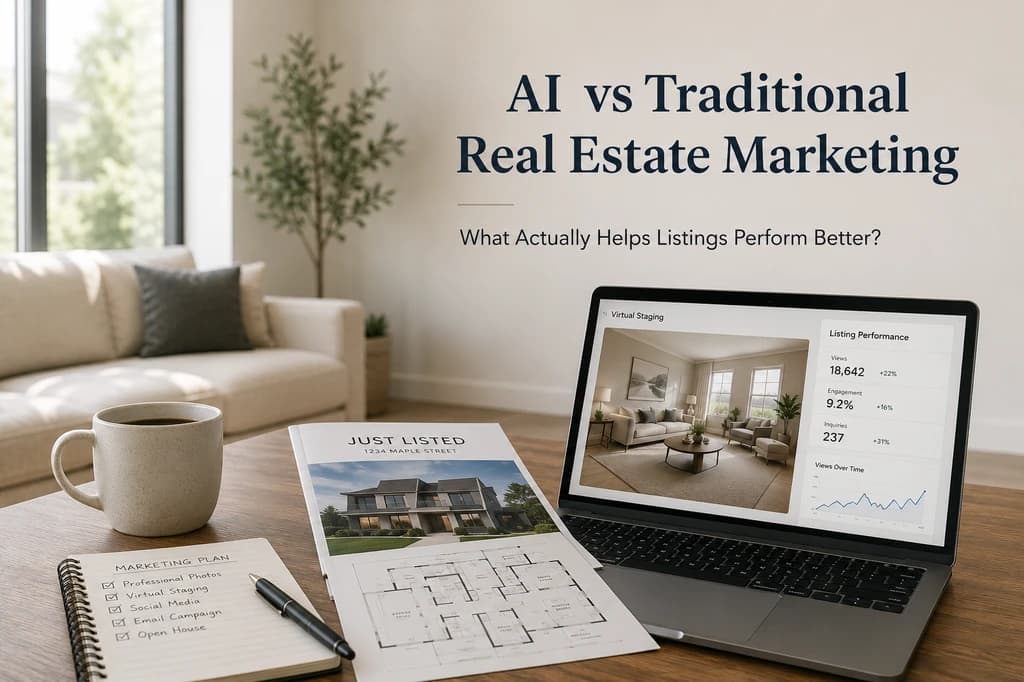
Minimal visual concept showing the balance between AI speed and human trust in modern real estate marketing.
Most real estate teams are not struggling with marketing volume. They are struggling with buyer clarity. AI improves speed and operational efficiency, while traditional marketing builds reassurance and trust.
The best strategies combine both to help buyers feel informed, supported, and confident throughout the decision process.
-
Direct Answer: AI and Human Marketing Are Stronger Together
AI marketing improves speed, automation, and buyer targeting, while traditional marketing builds trust, local credibility, and emotional reassurance.
The strongest real estate teams use both together, letting AI handle operational tasks while agents focus on guidance, judgment, and buyer confidence. What buyers see shapes what they feel, and that influences what they decide.
Expert Insight
A brokerage automated lead response with AI, but listings improved only after agents increased local walkthroughs and open houses. Faster systems helped generate interest, while in person reassurance helped buyers feel confident enough to move forward.
The real advantage came from combining speed with trust rather than relying entirely on one approach.
-
Why This Matters: The Psychology of Real Estate Decisions
Most buyers hesitate not because the property is wrong, but because the listing feels unclear or difficult to trust. Slow responses, weak visuals, and incomplete presentation often reduce confidence before a showing even happens. Many listings lose buyers before a showing because the mental effort required to interpret the space feels too high.
As highlighted in our analysis of AI powered visualization and listing performance, buyers spend more time on listings that feel visually clear and engaging. Human reassurance still plays a major role in helping people move forward with confidence.
-
The Visualization Gap: Why Most Marketing Fails to Inspire Action
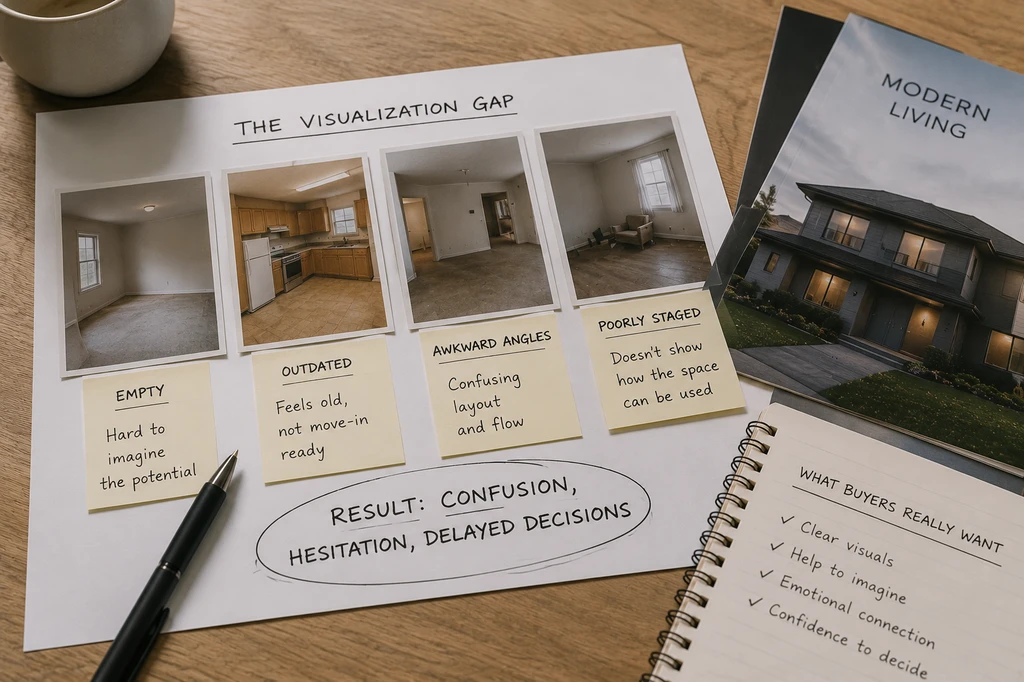
Visualization gaps in listing media often create buyer hesitation and delayed decisions.
Empty rooms, outdated photos, awkward angles, and poorly staged spaces often create buyer confusion instead of confidence. The issue is not only visual quality. Many buyers struggle to imagine how they would actually live in the space.
As explored in our deep dive on the visualization gap, confusing visuals rarely create curiosity in real estate. More often, they create disengagement.
-
From Exposure to Decision System: The Shift in Real Estate Marketing
Traditional real estate marketing focused on exposure through print ads, networking, and open houses. AI shifts the focus toward faster matching, automated communication, and clearer listing experiences through data and visualization.
Even with better automation and targeting, buyer decisions still depend heavily on trust, emotional readiness, and human reassurance.
-
AI vs Traditional: Real-World Use Cases (and Where Each Wins)
The difference is not just digital versus human. It is operational efficiency versus emotional reassurance:
- You need to qualify and follow up with leads instantly
- There’s a high volume of listings needing standardized, high-quality media
- Your team wants to scale operations or serve remote buyers efficiently
- Listing media needs quick enhancement—virtual staging, renovation previews, or batch editing
- Negotiation is nuanced, and buyers want local insights
- Building community reputation or working off referrals
- Clients have emotional hesitation or complex criteria
- Face-to-face reassurance could make or break a deal
The best teams connect these strengths intentionally. Recent analysis of AI-driven deal closures shows operational efficiency rises, but only when teams don’t neglect trust and personal interaction. -
Framework: The Speed vs Trust Model for Real Estate Marketing Decisions
Strong real estate marketing improves both decision speed and buyer confidence. AI supports faster workflows and automation, while traditional methods strengthen trust and reassurance.
Relying too heavily on either side can create problems, from impersonal experiences to slower and less consistent operations.
-
Operational Perspective: Media Workflows and Scalability Are the New Bottlenecks
- At higher listing volumes, media workflows often slow down because of file confusion, MLS formatting issues, duplicated work, and coordination delays.
- The Styldod Smart Media Module helps teams standardize asset management, accelerate listing ready visuals, and improve operational collaboration.
- As noted in the state of AI marketing data review, scalable and reliable workflows are becoming increasingly important for brokerage and multi listing performance.
-
Visualization Tools: Bridging the Gap, Responsibly

Contrasting unfurnished and AI-staged spaces illustrates ai vs traditional real estate marketing for listings and highlights how AI improves real estate listing performance by enabling transparent, effective visual staging strategies.
Modern AI visualization platforms like REimagineHome.ai help agents preview furnished interiors, renovation concepts, and layout possibilities before physical work begins. This makes it easier for buyers to understand a property’s potential, especially in vacant or outdated homes.
As explained in our guide to the visualization gap, visual clarity should never come at the cost of trust. Listing visuals must represent spaces honestly and include proper disclosure when needed.
The goal of visualization is not to mislead buyers. Strong visualization reduces uncertainty without creating false expectations.
-
Real-World Constraints and Context: Why No Single Approach Works Everywhere
- Not every brokerage needs enterprise level AI systems.
- Smaller and hyper local teams often face budget limits, slower adoption, and referral driven workflows.
- Some listings benefit from advanced digital targeting, while others depend more on local relationships and trust.
- The right strategy depends on listing type, buyer demographic, team structure, operational volume, and available resources.
The best decisions fit your real market context rather than technology hype or outdated habits.
-
Practical Guidance: What to Use, When (and What to Avoid)
Best uses for AI tools:
- Predictive lead filtering for high-volume listings
- Automating media consistency across portfolios
- Enhancing vacant or renovation-heavy properties with virtual staging
- Batch processing and MLS compliance pipelines
- In-person open houses and tours
- Relationship-driven referrals
- Complex negotiations and emotional reassurance
- Community and brand-building events
Mistakes to avoid:- Relying on automation for every touchpoint (feels impersonal)
- Using over-edited or misleading photos (damages trust and compliance)
- Building a tech stack your team can’t operate consistently
- Ignoring workflow and operational challenges at scale
-
Styldod’s View: Visualization and Media as Infrastructure, Not Add-Ons
Most real estate media tools solve only one problem like editing, staging, or automation. Strong listing performance depends on combining visualization clarity, media workflows, listing ready assets, and buyer trust.
Styldod connects AI visualization, professional editing, and the Smart Media Module into one scalable workflow system for better buyer engagement and operational consistency.
Visualization Scenario
A vacant condo with empty room photos can feel cold and difficult for buyers to interpret. Virtual staging and clear floorplans help the space feel more understandable, comfortable, and livable.
That shift is what decision grade visualization is designed to solve by helping buyers move from uncertainty to confidence more quickly.
AI vs Traditional Real Estate Marketing: FAQ
-
Is AI marketing better than traditional real estate marketing?
AI improves speed and automation, while traditional marketing builds trust and relationships. Most strong real estate strategies combine both. -
Can AI replace real estate agents?
AI helps with repetitive tasks, but human expertise, negotiation, and emotional guidance still matter. -
How does AI improve listing performance?
AI supports faster responses, predictive targeting, and clearer listing visualization for stronger buyer engagement. -
Why is visualization important in real estate marketing?
Visualization reduces uncertainty and helps buyers understand a property more confidently. -
Are AI generated listing images allowed on MLS?
Rules vary by MLS, but agents should disclose edits and maintain accurate property representation. -
What is the biggest risk with AI marketing?
Too much automation can make the experience feel impersonal and reduce buyer trust. -
Do small teams need complex AI systems?
Most small teams benefit from simple tools that reduce repetitive work and improve listing clarity. -
What is the visualization gap?
The visualization gap is the disconnect between what buyers see and what they need to feel confident. Learn more in our full explainer.
Conclusion: Confident Decisions Need Both Speed and Trust
The real challenge is not choosing between AI and traditional marketing. It is reducing buyer friction while still making people feel understood and confident.
AI improves speed and scalability, while human agents build trust and emotional reassurance. The strongest strategies combine both to create clearer and more confident decisions.